Better decisions. Useful technology. Work that matters.
Daniel J. Dick
Information technology professional, writer and creator working across healthcare technology, artificial intelligence, resilient systems and other consequential problems.
Drawing on more than four decades in information technology, I explore difficult problems through careful questioning, evidence, systems thinking and practical experience.
Featured Work
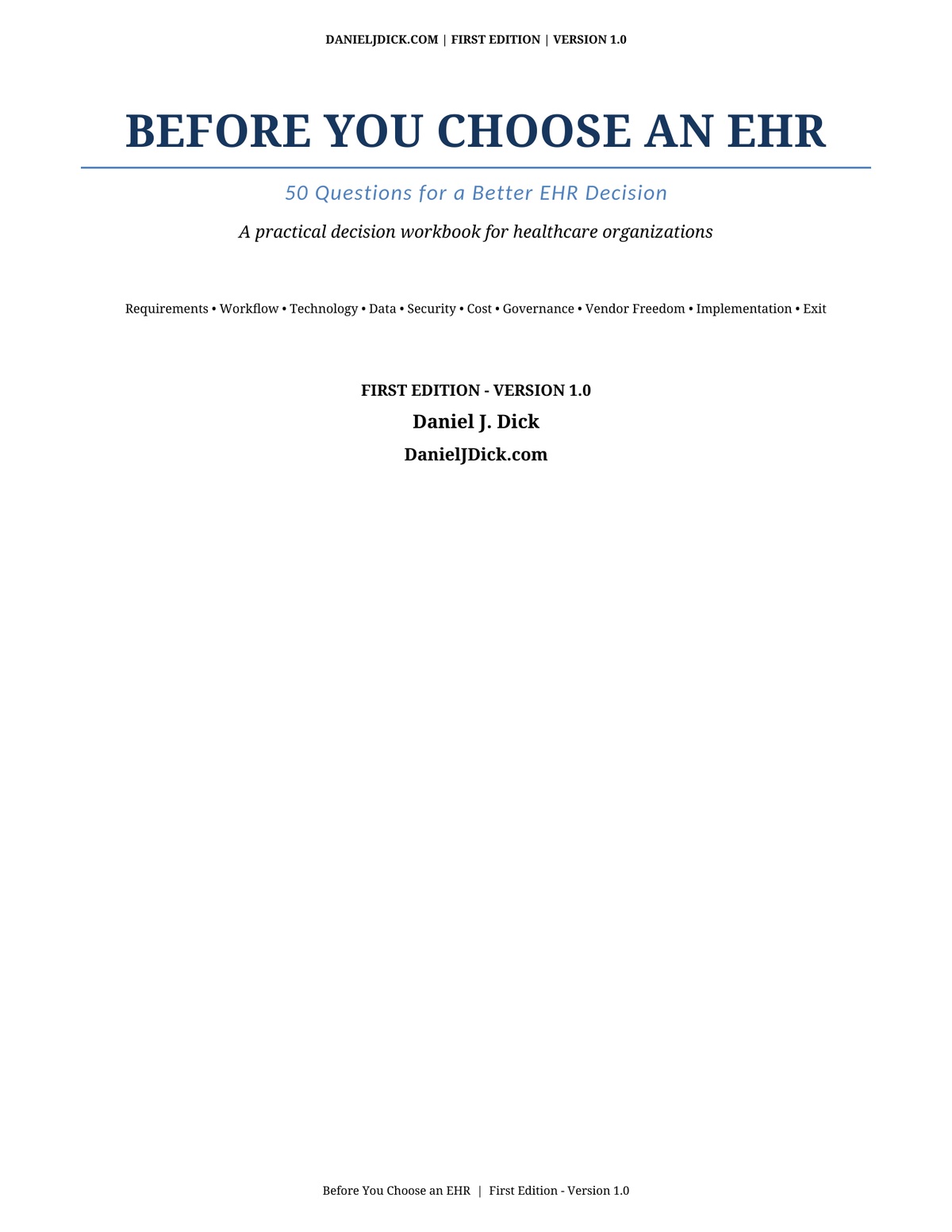
Before You Choose an EHR
50 Questions for a Better EHR Decision
A practical, vendor-neutral workbook for healthcare organizations considering whether to retain, improve or replace an electronic health record system.
The workbook develops 50 questions across clinical workflow, technology, interoperability, security, implementation, economics, contracts, governance and long-term flexibility—helping teams investigate what they need to know before making a difficult-to-reverse decision.
The free guide is useful on its own. Use it with your team and share it with colleagues—no purchase required.
Four Decades of Technology Experience
My work in information technology has crossed healthcare, universities, technology companies and complex enterprise environments—from systems administration, databases and large-scale implementations to healthcare interoperability and emerging artificial intelligence. Across very different technologies, the recurring challenge has been the same: understanding how systems really work, where they can fail, and how to make better decisions about what comes next.
EHR Decisions and Healthcare IT
Experience with EHR technical operations, interoperability, interfaces, data movement, upgrades and implementation support—combined with an interest in helping organizations ask better questions before making consequential healthcare technology decisions.
Enterprise & Long-Lived Systems
Experience across enterprise systems, databases, systems administration, migrations and technical operations, with particular interest in reliability, technical debt, institutional knowledge and what happens when important systems outlive the people who originally designed them.
Artificial Intelligence & Emerging Technology
Continuing study and practical exploration of artificial intelligence and machine learning, with an emphasis on useful applications, sound reasoning and distinguishing genuine capability from hype or unnecessary complexity.
Selected Writing
I write about technology, organizations and the difficult decisions that arise when systems become deeply embedded in the institutions that depend on them. Here are some recent explorations.
When Systems Outlive Their Designers
What happens when critical technology remains in service longer than the people, assumptions and institutional knowledge that created it?
This four-part series examines long-lived systems, technical debt, disappearing expertise, resilience and the organizational risks that accumulate when essential technology outlives its original designers.
About Daniel
I’m Daniel J. Dick, an information technology professional with more than four decades of experience in computing and information systems. My work has taken me through healthcare, universities, technology companies and other complex environments, with experience spanning systems administration, databases, enterprise applications, healthcare technology, interoperability and technical operations.
I earned a B.S. in Mathematics, with a minor in Physics, from California State University, Fresno, completed graduate-level study in advanced systems and databases at Stanford University, and later earned an MBA through Haroun Education Ventures. More recently, my studies have included artificial intelligence and machine learning.
Much of my work today grows from a simple interest: understanding consequential problems well enough to ask better questions about them—and then creating something useful from the answers.
Work With Me
I’m interested in work where careful analysis, technical experience and good questions can make a meaningful difference.
That may include healthcare technology and EHR decision support, enterprise systems and technical strategy, artificial intelligence, or other difficult technology problems where an independent perspective can help clarify what should happen next.
If you have a problem worth examining, I’d be glad to hear about it.